





Cost optimization
Cloud Budgeting and Unit Economics for Series A and B

Your cloud bill can outrun your finance model long before revenue catches up. That gap hurts twice, because you lose margin, and you lose clarity.
At Series A and B, you can’t treat AWS cost like a dull back-office line item. You need budgeting frameworks and unit economics that tie cloud spend to gross margin, product growth, and cash runway. When you map spend to a business unit, you stop arguing about totals and start making better business decisions.
Why Series A and B companies need a different cloud budgeting model
Enterprise budgets assume stable systems and slow change. Your company doesn’t look like that. New features land fast, usage swings by cohort, and one AI feature can move your AWS bill before finance closes the month.
That is why top-down caps often fail. In 2026, reports on SaaS startup cloud cost practices keep stressing visibility, frequent reviews, and business-linked cost control. Investors now ask harder questions about efficiency, and cloud economics is part of that story.
What breaks when you budget cloud like a fixed IT line item
Shared services hide in the background. Data pipelines, observability, staging, and platform tools often sit in one bucket, so no product owner sees the full cloud cost.
Future costs also get harder to predict. If workload growth doubles but the budget stays flat, finance sees a miss, while engineering sees a product win. Both are right, and the model is wrong.
A public example sits outside startup land, but the lesson is useful. 37signals made infrastructure a margin decision, not an IT line item, when it rethought public cloud spend.
What a better startup budget should do instead
A better model maps AWS spending to products, teams, and customer growth. It also leaves room for experiments, because early-stage companies still need to test.
This quick comparison makes the gap clear:
| Model | Good for | Weak spot |
|---|---|---|
| Annual top-down cap | Stable estates | Misses workload swings |
| Team-only budget | Simple ownership | Hides shared cost |
| Product-linked budget | Better margin view | Needs clean tags |
| Unit-based budget | Best forecast signal | More setup work |
Upsides and tradeoffs:
- You get sharper cost accountability and less surprise on cloud bills.
- You keep engineering speed, because budgets match product reality.
- You need stronger tagging, cost allocation, and monthly reviews.
- You also need finance and engineering in the same room more often.
See how much you can save on your stack
Pick your team’s tools!
Click to select one or more tools.


What’s your company size?
Just click to select.
What’s your business email?
We'll send you calculations right away
The email is flying to your inbox!
Beyond discounts, you may qualify for up to $100K in AWS credits.

How to break cloud spend into unit economics you can actually use
Before you measure anything, clean up cost data. If your AWS accounts, tags, and environments are messy, your unit economics will be messy too.
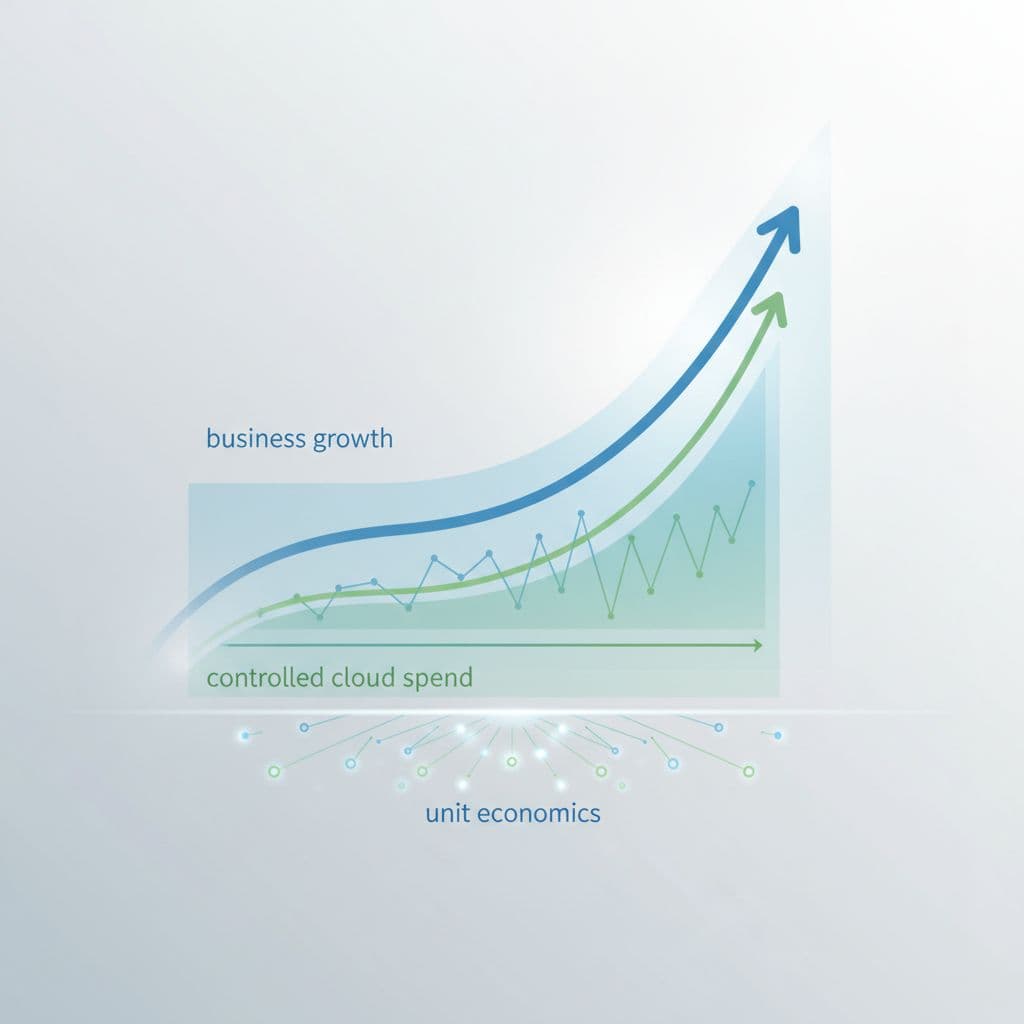
Diagram 1: AWS accounts + cost and usage data -> tagging + allocation rules -> business unit cost -> unit metric -> margin decision
Choose one unit that matches how your business makes money
B2B SaaS teams often start with cost per customer or cost per active account. Marketplaces usually care more about cost per transaction. AI products may need cost per inference or cost per token, because revenue and cloud usage move at the request level.
Use one primary unit first. If you track five at once, you create noise.
This step is where many teams fail. Shared VPCs, platform teams, logging, security, and data tooling all support the product, even if no invoice line says so.
Use native AWS tools, including AWS Cost Explorer, AWS Budgets, AWS Cost and Usage Report, and AWS Config. Then apply a cost allocation process that fits how your cloud infrastructure works. If you use AWS cloud plus Google Cloud, keep the same business unit rules across both.
If you can’t allocate shared costs with confidence, your unit economics are only a guess.
Use unit metrics to spot margin leaks early
A unit metric is the signal, such as cost per transaction. Unit economics is the full math, including price, gross profit, and support cost. That difference matters.
A simple table helps you pick the right lens:
| Unit metric | Best fit | What it reveals |
|---|---|---|
| Cost per customer | B2B SaaS | Margin by account |
| Cost per active user | Product-led SaaS | Usage-heavy cohorts |
| Cost per transaction | Payments, marketplaces | Thin-margin events |
| Cost per inference | AI apps | Model and workload efficiency |
| Cost per token | LLM products | Pricing risk fast |
For practical setups, this 2026 cloud cost optimization guide is useful because it connects cost allocation, anomaly checks, and unit cost metrics.
Upsides and tradeoffs:
- You can pinpoint cost drivers early and protect gross margin.
- You can test pricing with real AWS cloud economics, not guesses.
- You need granular cost data and disciplined tagging.
- You may spend a few weeks cleaning old AWS environments first.
Which cloud and company metrics should you track every month?
Track the numbers that change action. A dashboard stuffed with 40 charts feels safe, but it weakens financial management.
The small set of metrics that gives you real control
These are the monthly numbers most Series A and B teams watch:
| Metric | Healthy direction | Why it matters |
|---|---|---|
| Gross margin | Rising | Tells you if cloud investment pays off |
| CAC payback | Often under 18 months | Protects runway |
| LTV:CAC | Around 3:1 or better | Shows sales efficiency |
| Net revenue retention | Above 100% is strong | Supports scale |
| Rule of 40 | Near or above 40 | Balances growth and profit |
| Cost per customer | Flat or falling | Exposes cloud cost drift |
Add two cloud-specific views: AWS spend trend and cost per workload. That pairing helps you separate healthy growth from waste. Current 2026 cloud cost management trends point to real-time, granular cost intelligence as the new baseline.
How to read trends instead of chasing one bad month
Watch weekly and monthly trend lines. Cost anomalies, forecast drift, and temporary cost spikes matter more when they repeat.
If one model endpoint jumps for three weeks, you have a cost anomaly detection problem. If the spike hits only once during a launch, you may only need a better expected cost range.
Upsides and tradeoffs:
- You see margin leaks before they hit the board deck.
- You improve cloud financial management with fewer, clearer metrics.
- You must agree on one definition for each metric.
- You also need owners who act on the numbers.
How to build a Series A budget that funds growth without hiding waste
Series A budgets should be simple, owned, and reviewed monthly. The cleanest model splits spend into base cost, growth cost, and experiment cost.

Diagram 2: Base budget -> growth budget -> experiment budget -> owner review -> monthly forecast update
The three budget buckets that keep your plan honest
Base cost is the spend needed to run the current product. Growth cost is the spend tied to expected customer and usage growth. Experiment cost covers new bets, like a fresh AI feature or a heavy analytics pilot.
| Bucket | Purpose | Owner | Control method |
|---|---|---|---|
| Base | Keep current service live | Eng lead | Rightsizing and utilization |
| Growth | Support forecast demand | Product + finance | Unit-based forecast |
| Experiment | Fund tests | Feature owner | Time-boxed budget |
This works because each bucket has a cost center and clear cost accountability. It also makes AWS cost management easier when finance asks why spending moved.
What engineering teams need to own in the budget process
Engineering should own tagging, workload review, and budget variance notes. Finance should own forecast logic and margin tracking. Together, you build one monthly view of business value achieved per cloud dollar.
If you want tactical ideas, these 2026 cloud cost optimization best practices cover commitments, rightsizing, and cost reductions that fit early-stage teams.
Upsides and tradeoffs:
- You fund growth without burying waste in one big pool.
- You make cost analysis part of product planning.
- You need steady review cadence, not one-off cleanup.
- Experiments can still spill over unless owners close them fast.
Free virtual cards for non-EU residents
Open in 1 working day, issue 100 virtual cards, and get up to 1.25% cashback.
Get a free account
How a Series B budget shifts from control to scale
By Series B, the company is larger, and the budget needs more slices. Product lines, regions, customer segments, and workloads on AWS now affect margin in different ways.
Where more detail helps and where it only adds noise
More detail helps when it changes pricing, roadmap, or support decisions. It adds noise when no one acts on it.
If enterprise customers run heavy data jobs, a blended cost per customer hides the problem. In that case, you need a detailed cost breakdown by segment or workload. Still, slicing every cloud resource by team, region, and feature can slow decisions.
| Budget focus | Series A | Series B |
|---|---|---|
| Primary view | Total spend + unit trend | Product and segment margin |
| Ownership | Team leads | Team + product + finance |
| Reporting depth | Monthly core view | Monthly plus cohort slices |
| Governance | Light controls | Stronger cost governance |
How to keep growth visible while tightening cost discipline
Use alerts, owners, and review cadence. Also keep one view for growth signals and one for efficiency signals.
Tools can help, but the operating model matters more. A scan of startup cloud cost management software options shows many management tools offer business units, alerts, and cost tracking. Those features only work when your team already agrees on cost drivers.
Upsides and tradeoffs:
- You get better margin visibility across products and segments.
- You make future spend easier to forecast.
- You can drown in detailed cost reports.
- More controls can frustrate teams if rules feel arbitrary.
How free AWS credits and discounts can improve your cloud economics
Credits buy time. They lower early cloud expenditure, reduce the AWS bill, and protect runway while revenue catches up.
Spendbase offers up to $100k in AWS credits for eligible startups. That can soften early AWS spending, especially when AI inference or data workloads hit before pricing matures.
When credits help and when they create false comfort
Credits help when you use them to fund product growth, not to hide bad cloud usage. If your cost per customer worsens while credits mask the bill, the problem is still there.
How to turn discounts into lasting savings
Pair credits with rightsizing, cost allocation, budget reviews, and cost optimization. Keep tracking the underlying AWS cost as if the credit did not exist. That is how cost savings survive after the credit runs out.
Upsides and tradeoffs:
- Credits improve early margin and give you room to learn.
- Discounts can delay painful infrastructure choices until the product fits.
- They can also hide waste and weak cost governance.
- The bill returns fast if you don’t fix the base model.

We can unlock discounts on 10,000+ tools you already use.
Conclusion
Clear budgets and clear unit economics give you control over cloud spend, margin, and runway. That matters more in 2026, when investors expect growth with discipline and AWS usage can rise faster than revenue.
Start small. Pick one business unit, define one unit metric, and build one monthly dashboard that shows spend, margin, and trend. When you can trace cloud cost to business value, you make better calls on pricing, hiring, product bets, and profit.


Get discounts on your team’s favorite apps
Find deals for 10%, 30%, or even 70% off in our discount marketplace.
Check Discounts