





Cost optimization
Why the Azure Ecosystem Is the Secret Weapon for B2B Startups

For many B2B startups, the biggest challenge is not building the product itself.
Commonly, the hard part is building fast enough while maintaining scalability, reliability, and operational efficiency.
This is where the Azure ecosystem becomes far more than a hosting platform.
When utilized efficiently, it can become a real secret weapon for scaling B2B startups. In this article, we’ll explore how.
What Makes Azure Stand Out
Azure goes far ahead of traditional fragmented infrastructure approaches, providing a more connected, scalable, and operationally efficient ecosystem for modern B2B startups.
See a table below exemplifying these core impact areas.

Altogether, this significantly reduces operational friction for B2B startups, especially during MVP development and early scaling stages.
| Traditional Infrastructure Approach | Azure Ecosystem Approach |
| Multiple disconnected tools and services | Integrated cloud-native ecosystem |
| Manual infrastructure management | Managed services and automation |
| Delayed AI experimentation | Faster AI prototyping |
| Slower deployment cycles | CI/CD and automated deployments |
| Gradual scalability planning | Cloud-native scalability from day one |
| Infrastructure optimized for survival | Infrastructure optimized for experimentation |
Besides, Azure excels among other cloud providers in several key areas, especially its hybrid cloud capabilities, which allow businesses to seamlessly connect on-premise infrastructure with cloud services.
Explore more differentiators in the comparison below.
| Azure vs AWS vs GCP: Quick Comparison | |||
| Azure | AWS | Google Cloud | |
| Startup credits | Up to $250K | Up to $100K | Up to $200K |
| Hybrid cloud support | Very strong | Strong | Strong |
| Microsoft ecosystem integration | Excellent | Moderate | Moderate |
| Ease of enterprise adoption | Very strong | Strong | Strong |
| Multi-cloud flexibility | Strong | Moderate | Strong |
| DevOps ecosystem | Azure DevOps + GitHub | Mature cloud-native tooling | Kubernetes-focused workflows |
| Open-source friendliness | Strong | Strong | Very strong |
Besides, one of Azure’s biggest advantages is that it goes far beyond traditional cloud infrastructure.
Instead of offering isolated services, Azure provides a deeply connected ecosystem.
Let’s explore it below.
See how much you can save on your stack
Pick your team’s tools!
Click to select one or more tools.


What’s your company size?
Just click to select.
What’s your business email?
We'll send you calculations right away
The email is flying to your inbox!
Beyond discounts, you may qualify for up to $100K in AWS credits.

Inside the Azure Ecosystem: Key Services & Tools for B2B Startups
One of Azure’s biggest advantages for startups is that it provides a broad ecosystem of managed services that significantly reduce infrastructure complexity for startups.
Thus, instead of building operational layers manually, teams can leverage ready-to-scale Azure services across numerous areas, including:
- Deployment;
- AI experimentation;
- Monitoring;
- Databases;
- Networking;
- Automation;
- Cloud-native infrastructure.
For B2B startups, this creates several major advantages:
- Faster deployment;
- Easier scalability (without constant infrastructure redesign);
- Simplified AI experimentation;
- Built-in security;
- Reduced operational complexity for engineering teams;
- Strong DevOps;
- Better infrastructure cost visibility.
This way, rather than spending months assembling and maintaining fragmented infrastructure stacks, startups can focus more engineering capacity on product innovation and customer growth.
Below are some of the most impactful Azure services for modern B2B startups.
| Azure Service | Primary Role | Core Features |
Azure App Service | Managed web hosting | – Managed hosting – Autoscaling – CI/CD integrations – SSL support – Multi-language runtime support |
Azure Functions | Serverless backend execution | – Serverless execution – Event triggers – Autoscaling – API integrations – Usage-based pricing |
Azure AI Services | Managed AI capabilities | – Prebuilt AI APIs – OCR – Speech recognition – Translation – Document intelligence |
Azure OpenAI Service | LLM infrastructure | – GPT model access – Prompt experimentation – Enterprise AI security – Scalable inference |
Azure AI Search | Semantic and vector search | – Semantic search – Vector search – Indexing – Retrieval pipelines – AI enrichment |
Azure Kubernetes Service | Container orchestration | – Managed Kubernetes – Autoscaling – Container orchestration – Rolling deployments – Monitoring integrations |
Azure DevOps | CI/CD and engineering workflows | – CI/CD pipelines – Repository management, automated testing, deployment automation |
Azure Cosmos DB | Scalable distributed database | – Global replication – Low-latency access – Flexible schema – Autoscaling throughput |
Azure Front Door | Global traffic routing | – CDN integration – Traffic routing – Edge caching – Load balancing – Ffailover support |
Azure Monitor | Monitoring and observability | – Metrics collection – Logging – Alerting – Dashboards – Observability tooling |
Together, these services allow startups to establish cloud-native foundations much earlier, all without added operational complexity.
Core Impact Areas of Azure for B2B Startups
Azure’s impact on B2B startups is often overlooked.
Many startups underestimate how strongly infrastructure decisions can affect execution speed, scalability, and long-term growth.
So, how exactly can Azure become a secret weapon for B2B startup growth?
Let’s explore.
Azure Credits Change the Economics of MVP Development
One of the biggest advantages of the Azure ecosystem for early-stage B2B startups is access to startup credit programs.
Which can significantly reduce infrastructure pressure during MVP development and scaling stages.
In particular, some startup programs offer:
- Up to $5,000 in Azure credits for early-stage startups;
- Up to $150,000 through startup partner and accelerator networks;
- In some cases, combined infrastructure support opportunities reaching up to $250,000 for eligible startups and infrastructure providers.
For many startups, this creates more room for experimentation, product iteration, operational scaling, and more.
Explore more details about the difference it makes below.
| Without Azure Credits | With Azure Credits |
| Sequential experimentation | Parallel validation |
| Delayed AI testing | Early AI prototyping |
| Shared unstable environments | Dedicated testing environments |
| Manual deployment workflows | Early CI/CD automation |
| Infrastructure optimized for cost minimization | Infrastructure optimized for learning speed |
Operational Acceleration
Next on, operational acceleration is one of the biggest advantages of the Azure ecosystem.
Azure reduces much of the infrastructure management friction through managed services and integrated tooling.
For example:
- Azure App Service accelerates SaaS deployment;
- Azure Functions simplifies backend automation and APIs;
- Azure DevOps improves CI/CD automation;
- Azure Kubernetes Service simplifies scalable container orchestration.
This operational acceleration helps B2B startups accelerate product releases and reduce engineering time spent on operational maintenance.
See how below.
Operational Bottleneck | Traditional Timeline | Azure-Powered Timeline |
| Manual deployments | 1-2 weeks of setup and maintenance | 1–2 days with CI/CD automation |
| Complex backend scaling | Several weeks of infrastructure tuning | Several days with autoscaling and serverless services |
| Environment instability | Ongoing release delays and testing conflicts | Stable environments established within days |
| High DevOps overhead | Significant ongoing engineering involvement | Reduced operational management effort |
| Slower release cycles | Releases delayed by manual processes | Continuous delivery during MVP stage |
| AI experimentation setup | 2-6 weeks for infrastructure preparation | Several days with managed AI services |
| Scalability benchmarking | Often postponed until post-launch | MVP-stage load testing and autoscaling validation |
Azure Helps Startups Survive the “Valley of Death”
One of the biggest challenges for early-stage startups is surviving the period between initial product development and sustainable revenue growth, often referred to as the “Valley of Death.”
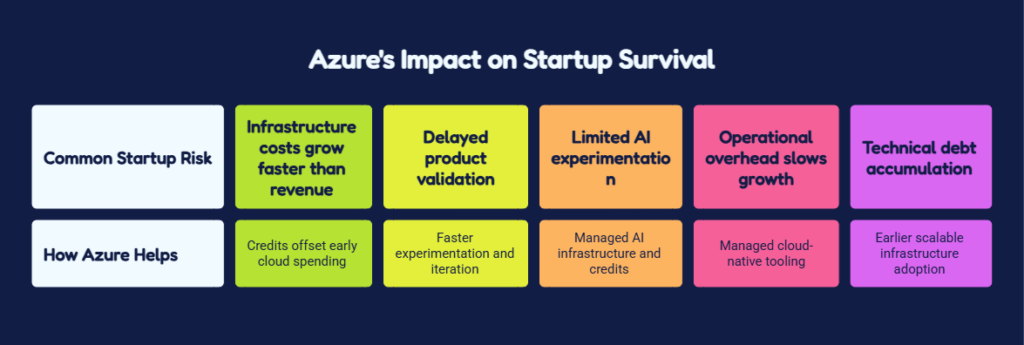
During this stage, startups often face a range of bottlenecks that can ultimately determine whether the company scales or stalls.
Azure can become a game-changer here by helping startups address many of these challenges (as shown in the table below).
| Common Startup Risk | How Azure Helps |
| Infrastructure costs grow faster than revenue | Credits offset early cloud spending |
| Delayed product validation | Faster experimentation and iteration |
| Limited AI experimentation | Managed AI infrastructure and credits |
| Operational overhead slows growth | Managed cloud-native tooling |
| Technical debt accumulation | Earlier scalable infrastructure adoption |
Global Infrastructure Without a Global Budget
Speaking of global infrastructure for scaling startups, traditional expansion approaches often fall short to address their needs.
Requiring full multi-region deployments, duplicated infrastructure, manual scaling processes, and large upfront cloud investments long before actual global demand exists.
In contrast, Azure enables a more gradual and cost-efficient scaling strategy. In doing some of it enables startups to:
> Start with optimized single-region architectures instead of investing in expensive multi-region deployments too early;
> Use CDN and edge delivery services to improve global performance without duplicating full infrastructure stacks;
> Adopt autoscaling and serverless infrastructure that adjusts resources dynamically based on actual demand;
> Reduce operational overhead through managed cloud-native services and built-in automation capabilities;
> Expand infrastructure incrementally as customer growth and regional demand increase.
Traditional Global Expansion | Azure-Powered Approach |
| > Full multi-region deployment early | > Start with optimized single-region architecture |
| > Duplicate infrastructure across regions | > Use CDN and edge delivery first |
| > Manual scaling and provisioning | > Autoscaling and serverless adoption |
| > High operational overhead | > Managed cloud-native services |
| > Large upfront infrastructure costs | > Incremental infrastructure expansion |
Especially Powerful for AI-Enabled B2B Products
For AI-enabled B2B startups, infrastructure decisions become even more critical. AI products require significantly more operational flexibility, for model experimentation, data processing, inference scaling, automation, etc.
Azure helps simplify much of this complexity through a connected ecosystem of AI, cloud-native, analytics, and DevOps services.
See how in more detail in the table below.
| AI Startup Challenge | How Azure Helps | Startup Impact |
| Expensive AI infrastructure setup | Managed AI services and startup credits | Lower barrier to AI experimentation |
| Slow model deployment | Integrated AI and cloud-native tooling | Faster time-to-market |
| High inference scaling complexity | Autoscaling and serverless infrastructure | More efficient AI workload scaling |
| Fragmented ML workflows | Unified ecosystem for data, AI, and deployment | Simplified operational management |
| Limited engineering capacity | Managed infrastructure and automation | Reduced DevOps overhead |
| Unpredictable AI costs | Monitoring and cost visibility tooling | Better infrastructure cost control |
| Scaling from MVP to production | Enterprise-grade cloud infrastructure | Easier long-term scalability |
How Startups Can Further Maximize Azure Efficiency
While Azure credits can significantly reduce infrastructure pressure during MVP and scaling stages, the biggest long-term advantage comes from using the Azure ecosystem efficiently from the beginning.
From our experience, the startups that gain the most value from Azure are usually not the ones spending the most.
They are the ones structuring infrastructure intentionally around 3 core pillars: 1 – real workload behavior, 2 – experimentation speed, 3 – operational efficiency.
In this section, we’ll break down exactly how to optimize Azure around these principles.
| Key Azure Areas to Optimize Early | ||
| Optimization Area | Recommended Approach | Why It Matters |
Infrastructure scaling | Use autoscaling and serverless services whenever possible | • Reduces idle costs • Improves scalability • Prevents overprovisioning |
Environment management | Separate development, staging, and production environments early | • Improves stability • Enables safer testing • Reduces production risks |
AI experimentation | Benchmark prompts, models, and workflows before scaling usage | • Reduces AI spending • Improves efficiency • Optimizes model selection |
Monitoring & observability | Introduce logging, metrics, and cost visibility early | • Detects costly workloads • Improves troubleshooting • Supports optimization |
CI/CD automation | Automate deployments from the beginning | • Speeds up releases • Reduces manual work • Improves consistency |
Storage optimization | Apply lifecycle policies and archive unused data | • Prevents storage cost growth • Optimizes retention • Reduces waste |
Resource governance | Use tagging and budgets for infrastructure visibility | • Improves cost control • Increases visibility • Strengthens governance |
Cloud-native architecture | Prioritize managed services over self-managed infrastructure | • Reduces maintenance • Improves scalability • Lowers operational overhead |
From our experience, these best practices help startups build and maintain an efficient Azure environment from the very beginning:
- Optimize infrastructure scaling – use Azure Autoscale, Azure Functions, and other serverless services whenever possible, align resource allocation with actual workload behavior, and avoid overprovisioned infrastructure that increases idle cloud costs;
- Separate environments early – establish dedicated development, staging, and production environments using Azure DevOps and Infrastructure as Code practices to improve deployment stability and testing reliability;
- Benchmark AI workloads before scaling – test prompts, models, inference workflows, and Azure OpenAI usage patterns early, monitor token and compute consumption, and optimize AI pipelines before expanding production workloads;
- Implement observability standards – introduce Azure Monitor, Log Analytics, and Application Insights early, standardize tagging and monitoring practices, and continuously identify expensive or underutilized workloads;
- Automate CI/CD workflows – implement deployment automation through Azure DevOps or GitHub Actions, reduce manual release management, and streamline testing and rollback processes to accelerate iteration cycles;
- Optimize storage lifecycle management – apply Azure Blob Storage lifecycle policies, archive infrequently accessed data automatically, and separate active and cold storage to reduce long-term storage costs;
- Establish resource governance practices – use Azure Policy, tagging standards, budgets, and cost management tooling to improve infrastructure visibility, workload ownership, and operational control;
- Prioritize cloud-native architecture – leverage managed Azure services such as Azure Kubernetes Service, Azure SQL, and Azure App Service to reduce infrastructure maintenance complexity and long-term DevOps overhead.

We can unlock discounts on 10,000+ tools you already use.
How Spendbase Helps Startups Maximize Azure Credits
For many B2B startups, accessing Azure credits is only part of the equation.
The bigger challenge is understanding which programs to apply for, how to structure applications correctly, and how to maximize the long-term operational value of those credits.
This is where Spendbase helps simplify the process:
- High approval success rates. Startups can apply with greater confidence through application workflows optimized around proven approval practices;
- End-to-end application management. Spendbase handles preparation, submission, follow-ups, and coordination – thus reducing operational overhead for internal teams;
- 360° optimization of savings opportunities. With Spendbase, startups can uncover additional Azure credit and infrastructure optimization opportunities that are often overlooked;
- Faster and more structured onboarding. We help startups align infrastructure and cloud optimization practices earlier without building operational processes from scratch;
- Reduced infrastructure pressure during growth. Optimized Azure usage and credits help preserve capital during MVP, experimentation, and scaling stages.
Reach out to see if you’re eligible for Azure credits.


Get discounts on your team’s favorite apps
Find deals for 10%, 30%, or even 70% off in our discount marketplace.
Check Discounts