





Cost optimization
How Microsoft Azure Credits Help Startups Survive the “Valley of Death”

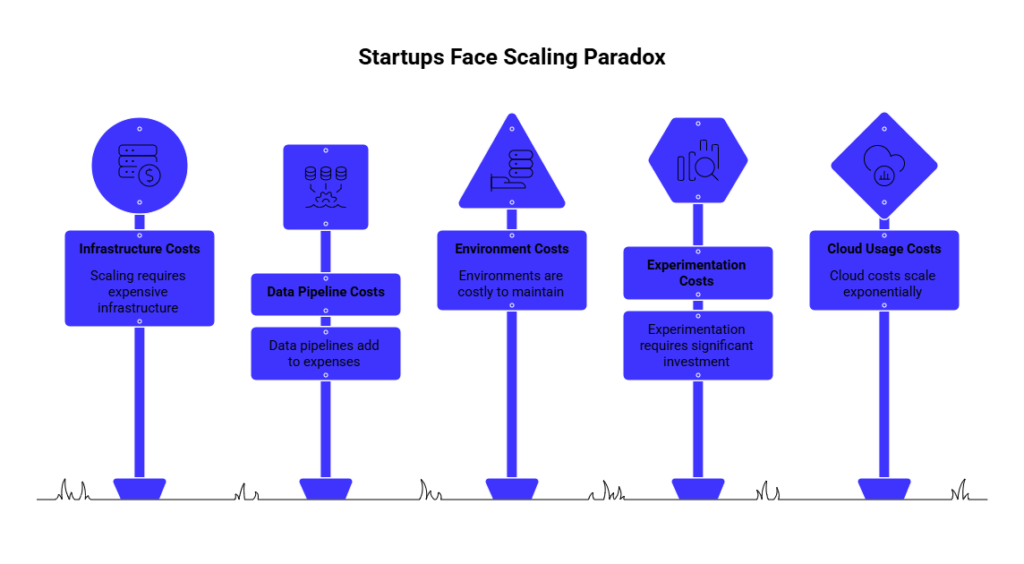
Early-stage startups face a unique paradox: they need to build and scale fast to validate their product.
However, scaling requires infrastructure, data pipelines, environments, and experimentation, all of which cost money. Without predictable revenue, even efficient teams can see their burn rate accelerate due to cloud usage alone.
Because of this, before startups reach stability, they often pass through one of the most critical and fragile stages of their lifecycle, commonly known as the “Valley of Death.”
While some manage to make it through, most do not.
What differentiates them is that those who survive are typically extremely disciplined with their spending. and this goes beyond simply managing every dollar.
To win the cost-efficiency game, a smart approach to spending is required, especially when it comes to cloud costs, which tend to scale exponentially during early growth.
In this article, we’ll explore how to manage them efficiently, focusing on how to use Azure credits strategically, avoid hidden cost traps, and build a cost-aware infrastructure that supports growth beyond the credit period.
A Closer Look at the “Valley of Death”
The “Valley of Death” is the phase where promising startups run out of cash before reaching sustainable revenue.
It is often characterized by the following:
> High burn rate with low or unpredictable revenue.
Expenses consistently outpace income, while revenue streams are either not yet established or fluctuate too much to support stable operations.
> Ongoing product development without proven product–market fit.
Teams continue investing in features and improvements without clear validation that the market truly needs or is willing to pay for the solution.
> Rapidly increasing infrastructure and operational costs.
Cloud usage, and team-related expenses grow as the product evolves, often faster than anticipated.
> Heavy reliance on experimentation and iteration.
Constant testing of features, pricing, and user flows is necessary, but each iteration consumes time, compute resources, and budget.
> Limited visibility into unit economics and cost drivers.
Founders lack clear insight into cost per user, per feature, or per transaction, making it difficult to assess sustainability.
> Overprovisioned or inefficient early-stage architectures.
Systems are built for speed and flexibility rather than cost-efficiency, leading to unused resources and inflated spend.
> Pressure to scale before financial stability is achieved.
Startups feel compelled to grow their user base or expand features quickly, even when the underlying economics are not yet viable.
At this stage, even small inefficiencies or delays in validation can significantly shorten the runway and put the entire venture at risk.
Predicting the “Valley of Death”: An Actionable Checklist |
| ✅ Burn is growing faster than traction |
| ✅ Unit economics are unclear or negative |
| ✅ Cloud costs scale without proportional value |
| ✅ Runway is shrinking without a clear milestone ahead |
| ✅ Frequent pivots or lack of validation |
| ✅ Low-cost visibility across teams |
| ✅ Overprovisioned or always-on infrastructure |
| ✅ Experimentation without cost guardrails |
| ✅ Tooling sprawl or overlapping services |
| ✅ Growth in team or complexity without matching output |
| ✅ No clear path to monetization |
| ✅ No view of post-credit or real cost structure |
See how much you can save on your stack
Pick your team’s tools!
Click to select one or more tools.


What’s your company size?
Just click to select.
What’s your business email?
We'll send you calculations right away
The email is flying to your inbox!
Beyond discounts, you may qualify for up to $100K in AWS credits.

How Cloud Costs Push Startups Into the “Valley of Death”
Cloud costs are one of the most underestimated drivers of startup failure: they scale quietly, continuously, and often non-linearly with product activity.
The core issue is not just that cloud costs increase.
It’s that they increase faster than expected and often without direct correlation to business value. When left unmanaged, infrastructure begins to scale ahead of revenue.
This way, what should be a growth enabler turns into a silent drain on capital.
Unlike fixed costs, cloud spending expands with every decision. Every feature shipped, experiment run, and every user onboarded. In particular, common ways cloud costs escalate include:
- Always-on compute resources
Instances and services run 24/7 regardless of actual usage, especially in non-production environments.
- Overprovisioned infrastructure
Resources are sized for peak load rather than real demand, leading to consistent overpayment.
- Unused or forgotten resources
Old environments, test instances, and storage volumes remain active without clear ownership.
- Uncontrolled data growth
Logs, backups, and datasets accumulate without lifecycle policies, increasing storage costs over time.
- Experimentation without cleanup
Temporary features, models, or environments continue consuming resources after their purpose is fulfilled.
- AI and data-intensive workloads
Costs scale per request, query, or model run, making usage-driven workloads particularly expensive if not monitored.
- Fragmented ownership of costs
Different teams use different services without centralized tracking, making it hard to identify cost drivers.
How Cloud Costs Translate Into Spend Risk | |||
| Area | What Happens | Early Signal | What to Do |
| Compute | Idle or oversized instances run continuously | • Low CPU/memory utilization • Flat usage patterns overnight | → Rightsize instances → Implement autoscaling → Schedule shutdowns for non-prod |
| Storage | Data accumulates without cleanup policies | • Rapid growth in storage bills • Large volumes of cold data | → Apply lifecycle policies → Archive / delete unused data |
| Environments | Multiple dev/test setups stay active | • Many parallel environments with low activity | → Automate environment teardown → Use ephemeral environments |
| AI/ML usage | Pay-per-request or training costs scale with usage | • Sudden cost increases tied to model usage | → Optimize model selection → Limit usage → Monitor cost per request |
| Tooling | Overlapping services across teams | • Multiple tools solving the same problem | → Consolidate tools → Assign ownership → Audit usage regularly |
| Networking | High data transfer (egress) and inter-region traffic | • Unexpected spikes in bandwidth charges | → Optimize data transfer → Keep workloads in the same region |
| Monitoring & Logs | Excessive logging and high retention periods | • Large log volumes with little usage | → Reduce log verbosity → Shorten retention periods |
| Databases | Overprovisioned or always-on database instances | • Low query load but high running cost | → Use serverless or autoscaling databases → Optimize queries |
| CI/CD pipelines | Frequent builds and inefficient pipelines | • High frequency of builds with low value output | → Optimize pipelines → Reduce unnecessary runs |
| Orphaned resources | Unattached disks, IPs, snapshots remain active | • Resources without clear ownership | → Regular audits → Enforce tagging policies |
Microsoft Azure as a Cloud Provider of Choice: What Sets It Apart
Opting for Microsoft Azure is often a strategic choice, especially for startups that need both flexibility and scalable infrastructure from day one.
In particular, its key advantages include:
- Deep Microsoft ecosystem integration – seamless connectivity with Microsoft 365, Active Directory, GitHub, etc.
- Strong hybrid and multi-cloud support – enabling gradual migration, data residency control, and more complex architectures without locking into a single deployment model.
- Built-in capabilities for training, deploying, and scaling AI models, along with analytics and data pipelines.
- Security and compliance readiness – robust built-in security features, identity management, compliance certifications, etc.
Besides all the above-mentioned aspects, startup-friendly programs and credits are another game-changer.
Microsoft Azure offers up to $250K in credits for eligible software startups, which can help actively growing businesses significantly reduce early-stage infrastructure costs and extend their runways.
| Azure vs AWS vs GCP: Quick Comparison | |||
| Azure | AWS | Google Cloud | |
| Startup credits | Up to $250K | Up to $100K | Up to $200K |
| Hybrid cloud support | Very strong | Strong | Strong |
| Microsoft ecosystem integration | Excellent | Moderate | Moderate |
| Ease of enterprise adoption | Very strong | Strong | Strong |
| Multi-cloud flexibility | Strong | Moderate | Strong |
| DevOps ecosystem | Azure DevOps + GitHub | Mature cloud-native tooling | Kubernetes-focused workflows |
| Open-source friendliness | Strong | Strong | Very strong |
Azure’s Guide to Cost Efficiency: Tapping Into Credits
So, what are cloud credits exactly? Let’s take a closer look.
To put it short, Azure credits are:
- Non-cash grants provided through programs like Microsoft for Startups;
- Designed to help early-stage companies access cloud infrastructure without an immediate financial burden;
- Available in different tiers (based on startup stage, eligibility, program level, etc.);
- Can scale from tens of thousands up to six-figure amounts in cloud credits.
Besides, Azure credits can be applied across a wide range of Azure services (among 200+ services in the Azure ecosystem). Explore the main ones in the table below.
| Category | Services Covered | What It Enables |
| Compute | Virtual machines, containers, Kubernetes services, serverless functions | → Run applications → Scale workloads dynamically → Support backend services |
| Storage | Blob storage, managed databases, data lakes, backups, archives | → Store & manage data → Ensure durability → Support analytics workloads |
| AI & ML | Model training, inference, cognitive services, pre-built AI APIs | → Build, train, deploy AI models → Automate predictions → Integrate intelligent features into products |
| DevOps Tooling | CI/CD pipelines, monitoring, logging, testing environments | → Automate development workflows → Ensure continuous delivery → Maintain system performance |
| Networking & Security | Virtual networks, load balancers, firewalls, identity & access management, threat protection | → Secure applications → Manage access → Ensure compliance → Maintain high availability |
Free virtual cards for non-EU residents
Open in 1 working day, issue 100 virtual cards, and get up to 1.25% cashback.
Get a free account
How Azure Credits Help Surpass the “Valley of Death”

#1: Extend Runway Without Slowing Growth
Credits directly reduce burn rate by covering infrastructure costs,
This, in turn, allows startups to preserve cash for hiring, marketing, product strategy, and other business areas, and extend runway by months (which is sometimes long enough to reach the next funding round or revenue milestone).
#2: Enable Real Product Development (Not Just MVPs)
Startups can build production-grade systems from the start: including proper environments, scalable architectures, robust testing, and more.
This can help reduce technical debt that would otherwise slow them down later.
#3: Unlock Advanced Capabilities Early
Many startups delay using AI, analytics, or large-scale processing due to cost concerns.
Azure credits remove that barrier, allowing teams to experiment with advanced capabilities (ML pipelines, real-time analytics, etc.)
#4: Support Go-to-Market Readiness
As startups move closer to launch, credits allow teams to prepare for real users without a sudden increase in costs.
For example, teams can provision staging and pre-production environments that mirror real usage, test different traffic scenarios, and fine-tune performance and security before going live.
Azure Credits: Key Considerations
From what we’ve seen across multiple startup teams, Azure credits are a highly efficient way to reduce infrastructure costs. However, they can also create a false sense of efficiency if not managed carefully.
Let’s review the most common pitfalls and how to avoid them.
When using Azure credits, consider the following:
> Credits can hide inefficiencies. For example, overprovisioned resources, always-on environments, and overly complex or expensive services often go unnoticed while costs are covered, and show up only once real billing begins.
> Prepare for the “cliff effect”. When credits expire, infrastructure costs can spike suddenly, thus becoming one of the largest operational expenses almost overnight. To avoid this, build cost awareness early: track real usage, simulate post-credit spend, etc.
> Focus on unit economics. Understanding cost per API call, transaction, or user is what separates scalable products from ones that struggle as they grow.
> Optimize continuously. Rightsizing, autoscaling, and removing idle resources should be part of your regular workflow.

We can unlock discounts on 10,000+ tools you already use.
Final Thoughts
On the final note, the startups that successfully navigate the “Valley of Death” are not the ones that simply reduce costs, but the ones that understand them.
Azure credits are a powerful accelerator to achieve that.
However, like any other early-stage business decision or action, it should be treated strategically.
Considering that, the ultimate goal should be building a cost-aware and scalable foundation that can hold even after the credits are gone.
This is precisely where Spendbase can make a real difference: helping startups secure cloud credits and additional find pathways for Azure cost optimization.
Reach out to us to see if you’re eligible.


Get discounts on your team’s favorite apps
Find deals for 10%, 30%, or even 70% off in our discount marketplace.
Check Discounts