




Cloudflare Outage: What Broke, What It Cost, What to Fix

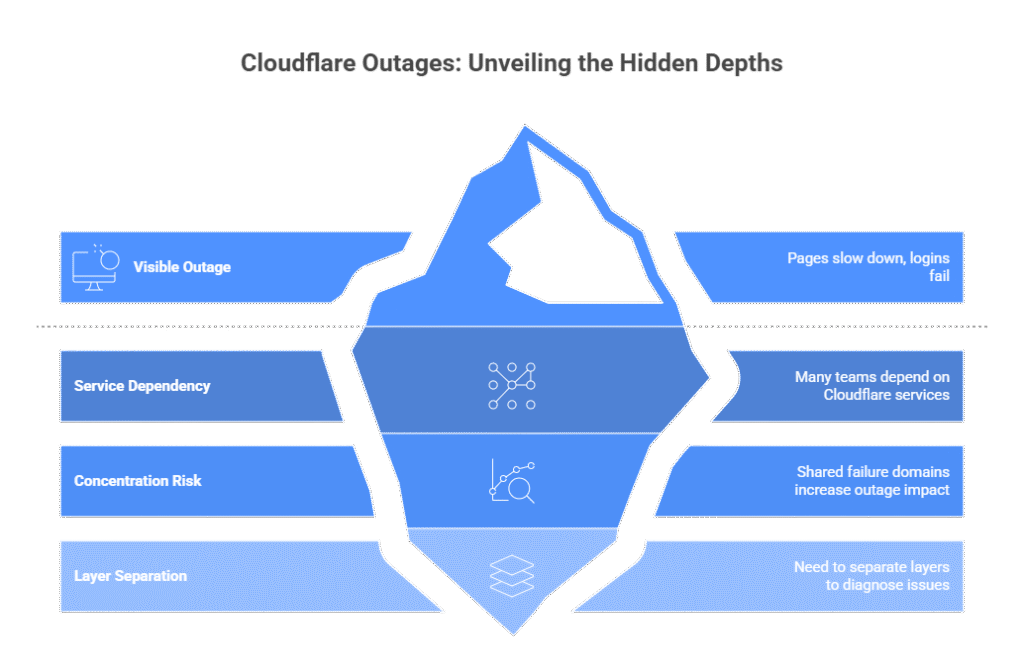
A bad Cloudflare outage rarely looks small from your side. Your pages slow down, logins fail, API calls time out, and support tickets pile up before anyone on your team has a clean answer.
That’s why one provider issue can turn into a business problem fast.
Cloudflare sits in front of many sites and apps for DNS, CDN, security, and edge logic, so one service outage can ripple far beyond a single page. If you’re a CFO, CTO, or developer, you need more than a status page refresh habit.
What Cloudflare does, and why so many teams depend on it
In plain English, Cloudflare is the layer between your users and your site or app. It helps route traffic, cache content, block attacks, enforce access rules, and run code at the edge. That means Cloudflare provides speed and protection, but it also becomes part of your core internet infrastructure.
For many teams, one Cloudflare service turns into several without much debate. You start with DNS. Then you add the Cloudflare CDN. Next come WAF rules, DDoS protection, Zero Trust access, Cloudflare Workers, R2 storage, and maybe Cloudflare’s Bring Your Own IP option. Soon, performance, security, auth, and app logic all depend on one vendor.
That scale is part of the appeal. Public 2026 estimates suggest the latest Cloudflare traffic statistics put Cloudflare in front of more than 20 percent of global internet request traffic. So when Cloudflare experienced issues, it can feel like the internet in general is breaking.
The services most likely to hurt when there is an outage
When DNS resolution fails, users can’t even find your app. When the CDN has trouble, pages may half-load or throw 5xx errors. If Zero Trust or Cloudflare Access stumbles, your team may get stuck at failed logins and endless redirects.
Cloudflare Workers problems hit app logic, auth flows, and API-driven jobs. Cloudflare dashboard trouble can block admin work during the worst possible minute. Meanwhile, broken analytics or tokens leave you blind while users are trying to access production systems.
Here’s the tradeoff in simple terms:
- Pros: fast delivery, strong security, easier operations, fewer moving parts.
- Cons: concentration risk, shared failure domains, harder incident isolation, and more customer traffic tied to one provider.
The same system that handles traffic, security, and routing can save you work on a normal day and multiply pain on a bad one.
Why a single Cloudflare issue can look like a wider internet failure
Because the Cloudflare network touches so many sites, a fault can look bigger than it is. A dashboard outage is not the same as a DNS outage. An origin failure is not the same as route withdrawals. Still, to end users, the error message often looks the same: the app won’t load.
That’s why you need to separate layers fast. If your origin on Amazon Web Services is healthy but DNS fails, you have a reachability problem, not an app crash. If the dashboard is down but cached pages still work, customer impact may be smaller than admin pain. If routes get pulled, connectivity breaks even when your servers are fine.
See how much you can save on your stack
Pick your team’s tools!
Click to select one or more tools.


What’s your company size?
Just click to select.
What’s your business email?
We'll send you calculations right away
The email is flying to your inbox!
Beyond discounts, you may qualify for up to $100K in AWS credits.

The biggest Cloudflare outages from 2023 to 2026, what broke and what users saw
When users see trouble, they often check Downdetector and the Cloudflare status page first. Both help, but neither tells the full story in real time. Downdetector is a crowd signal. The Cloudflare status page is the vendor record. You need both, plus your own monitoring.
This timeline gives you the main incidents with reported causes and visible impact, using UTC where timing is known.
| Date | Duration | Affected services | Root cause | What users saw |
|---|---|---|---|---|
| Jan 24, 2023 | 121 min | Service tokens, Zero Trust, Workers-related control functions | Bad code release overwrote token metadata | Failed access, admin issues, auth trouble |
| Oct 4, 2023 | About 3 hrs | 1.1.1.1, WARP, third-party DNS lookups | Internal resolver issue, with SERVFAIL spike | DNS failures, apps never loading |
| Oct 30, 2023 | 37 min | Workers KV | Deployment misconfiguration | Broken key-value reads, app instability |
| Nov 2, 2023 | Not clearly stated | Control plane, analytics | Public reports lacked full detail | Dashboard and monitoring disruption |
| Mar 21, 2025 | Not clearly stated | R2 and related systems | Elevated errors, full root cause not detailed publicly | Storage access problems |
| Nov 18, 2025 | About 6 hrs, per public analyses | Proxy traffic handling, multiple web services | Oversized bot management configuration file caused proxy crashes | Broad disruption, 5xx errors, broken pages and APIs |
| Feb 20, 2026 | 6 hrs 7 min | BYOIP routes, some site access | Config change plus software bug withdrew BGP routes | Subset of customers unreachable |
Public writeups on the 2025 and 2026 Cloudflare incidents and one analysis of the November 2025 disruption help fill in details between official updates and user reports.
Outages caused by code and configuration mistakes
Several recent outages were self-inflicted, not denial of service attacks or other malicious activity. On January 24, 2023, a code release broke service token metadata. On October 30, 2023, a Workers KV deployment misconfiguration took down a core dependency.
Then, on November 18, 2025, a configuration file that is automatically generated to manage threat traffic grew beyond its expected size. Reports said that file crashed the software system that handles traffic for a number of services.
That matters because your first instinct may be wrong. When Cloudflare suffered a service outage in these cases, the root cause was systems and processes failed, not an outside actor.
Outages caused by DNS and routing failures
DNS and routing faults cut deeper because healthy origins can still disappear. The October 4, 2023 incident hit DNS resolution hard enough that many users saw apps hang before the first byte.
Then, on February 20, 2026, Cloudflare’s Bring Your Own IP issue withdrew BGP announcements for a subset of customers who use Cloudflare’s bring your own IP. Cloudflare said about 4,306 prefixes were affected, and manual fixes stretched the duration of the incident to 6 hours and 7 minutes.
If traffic can’t be routed, your app may as well be unplugged.
Why Cloudflare outages matter to your business, not just your infrastructure
Downtime burns money in layers. You lose sales first. Then teams sit idle. Next comes support load, delayed releases, and trust damage that lasts longer than the outage takes.
Fresh 2026 benchmarks put average downtime around $5,600 to $14,000 or more per minute for many businesses, and a widely cited midpoint is about $9,000 per minute.
Large enterprises can reach $23,750 per minute, while smaller firms may lose hundreds to thousands per minute depending on timing and channel mix.
This quick map helps you discuss the impact in business terms.
| Outage type | What breaks first | Business effect |
|---|---|---|
| DNS failure | Site discovery, login, app entry | Lost sales, failed sessions, support spikes |
| CDN or proxy failure | Page delivery, checkout, media | Abandoned carts, slower pages, trust damage |
| Zero Trust or access failure | Staff login, admin tools | Idle teams, missed deadlines, stalled ops |
| Workers or API failure | App logic, automation, integrations | Delayed deployments, broken workflows |
| Dashboard or analytics failure | Visibility and control | Slower diagnosis, bad decisions under stress |
The hidden cost gets worse after recovery. As one review of vendor outage losses points out, recovery work often adds another large chunk to the bill.
Real-world examples of services that felt the impact
During major internet outages in the past, users reported trouble on sites including Uber Eats, Wikipedia, Steam, X, ChatGPT, Spotify, Shopify, Zoom, Canva, Coinbase, Fitbit, and Peloton. Public services also appeared in complaint threads. You should read those examples as visible effects, not clean proof that every brand had the same dependency path.
Still, the pattern is clear. Users trying to access popular apps don’t care whether the break sits in your origin, your edge, or your auth chain. They see failed access, blank pages, payment trouble, and rising frustration.
For a CFO, that means revenue risk. For a CTO, it means concentration risk. For a developer, it means your fallback path needs to work before the outage starts.
The lessons most teams miss after the status page turns green
The easy lesson is “Cloudflare’s services had a bad day.” The harder lesson is that your stack may be too tightly packed around one provider. Using Cloudflare for DNS, CDN, bot filtering, Zero Trust, and Cloudflare Workers can make operations simpler. It can also create one shared blast zone.
A common case-study pattern looks like this: traffic fails at the edge, staff can’t log in through Zero Trust, and the Cloudflare dashboard is also affected. So you lose customer access, admin access, and clear telemetry at the same time. That’s why postmortems should price downtime, not only discuss the impact in technical terms.
How you can reduce Cloudflare outage risk before the next incident hits
You don’t need a huge multi-vendor maze to lower risk. You need backups for the layers that fail first, plus stronger change control.
Build backups for the layers that fail first
Start with DNS. A secondary DNS provider is often the best value backup because DNS failure blocks everything upstream. If your app drives revenue, add a documented bypass path around the Cloudflare edge for emergencies. For some teams, cached static fallbacks and a multi-region origin design are enough. For others, a backup CDN path makes sense.
Use cost discipline here. Smaller teams usually don’t need full duplicate stacks. They do need a written map for how traffic gets routed when primary paths fail. If you’re reviewing vendors and spend together, it helps to compare redundancy cost with downtime cost. Tools that support cloud cost management discounts can make that tradeoff easier to model.

Improve monitoring, change control, and incident response
Run external uptime checks from outside your provider. Add synthetic tests for login, checkout, and API paths. Track the status page, but treat Downdetector as a signal, not a source of truth. Also, push for canary releases, automatic rollback, and config review on risky changes. The 2023 to 2026 incidents show how code and config mistakes can create a global outage feel without any DDoS event at all.
There’s also a finance angle. Vendor concentration isn’t only an engineering concern. It belongs in procurement. If your contracts, renewal terms, and fallback choices aren’t mapped, your team will pay for it later. A practical SaaS procurement guide can help you frame redundancy, vendor fit, and response obligations before the next disruption hits.

We can unlock discounts on 10,000+ tools you already use.
Conclusion
Cloudflare still brings real value. You can use Cloudflare’s speed and security without treating hope as your backup plan.
Your next move should be concrete. If you’re a CFO, model downtime cost against the price of redundancy. If you’re a CTO, cut concentration risk where one provider touches too many layers. If you’re a developer, build graceful fallbacks now, because when the next outage hits, calm preparation beats panic every time.


Get discounts on your team’s favorite apps
Find deals for 10%, 30%, or even 70% off in our discount marketplace.
Check Discounts