






Cost optimization
Why Enterprises Replace Legacy VPNs With Cloudflare Zero Trust

If you’re a CTO, CFO, or founder, you already know the pattern. Your team needs remote access, but the old VPN keeps adding friction, support tickets, and risk.
A legacy VPN was built for a world where most people sat in one office and most apps lived on one network. Your business doesn’t look like that anymore.
Remote work, cloud apps, contractors, and split teams changed the map. That’s why enterprise buyers are moving toward Cloudflare Zero Trust, and why the right choice now comes down to access model, cost, rollout risk, and user experience.
What a legacy VPN does, and where it still helps
A VPN encrypts internet traffic between a user and your company environment. It lets remote users reach a private network, internal applications, file shares, and older systems that were never designed for the public internet.
That still matters. If your employee is on airport Wi-Fi, a VPN adds a safe tunnel. If you still run old client-server apps, fixed ports, or a private network with brittle firewall rules, a VPN can be the shortest path.

Why businesses adopted VPNs in the first place
The old model made sense. One VPN server in a data center was cheaper than rebuilding every app. Your users signed in, got an IP address on the internal network, and worked as if they were in the office.
That model spread because it was simple to explain to leadership. It also solved real problems: encrypted traffic, basic remote access, and a clear way to reach internal files from home or while traveling.
The main ways teams still use VPNs today
Recent 2026 data shows that VPN use has narrowed, even if it hasn’t vanished. For a plain-language breakdown of how ZTNA differs from a traditional VPN, see this ZTNA vs VPN comparison.
| Use case in 2026 | Why teams still keep it | Current signal |
|---|---|---|
| Public Wi-Fi protection | Encrypts internet traffic fast | Still common for travelers |
| Access to older private apps | Works with legacy ports and protocols | Persistent in large enterprises |
| Basic privacy or geolocation | Masks source IPs for simple tasks | Smaller, non-core use case |
The takeaway is simple: VPNs still help in edge cases. They stop fitting well when remote work becomes the default.
See how much you can save on your stack
Pick your team’s tools!
Click to select one or more tools.


What’s your company size?
Just click to select.
What’s your business email?
We'll send you calculations right away
The email is flying to your inbox!
Beyond discounts, you may qualify for up to $100K in AWS credits.

Why you may need to replace your VPN now
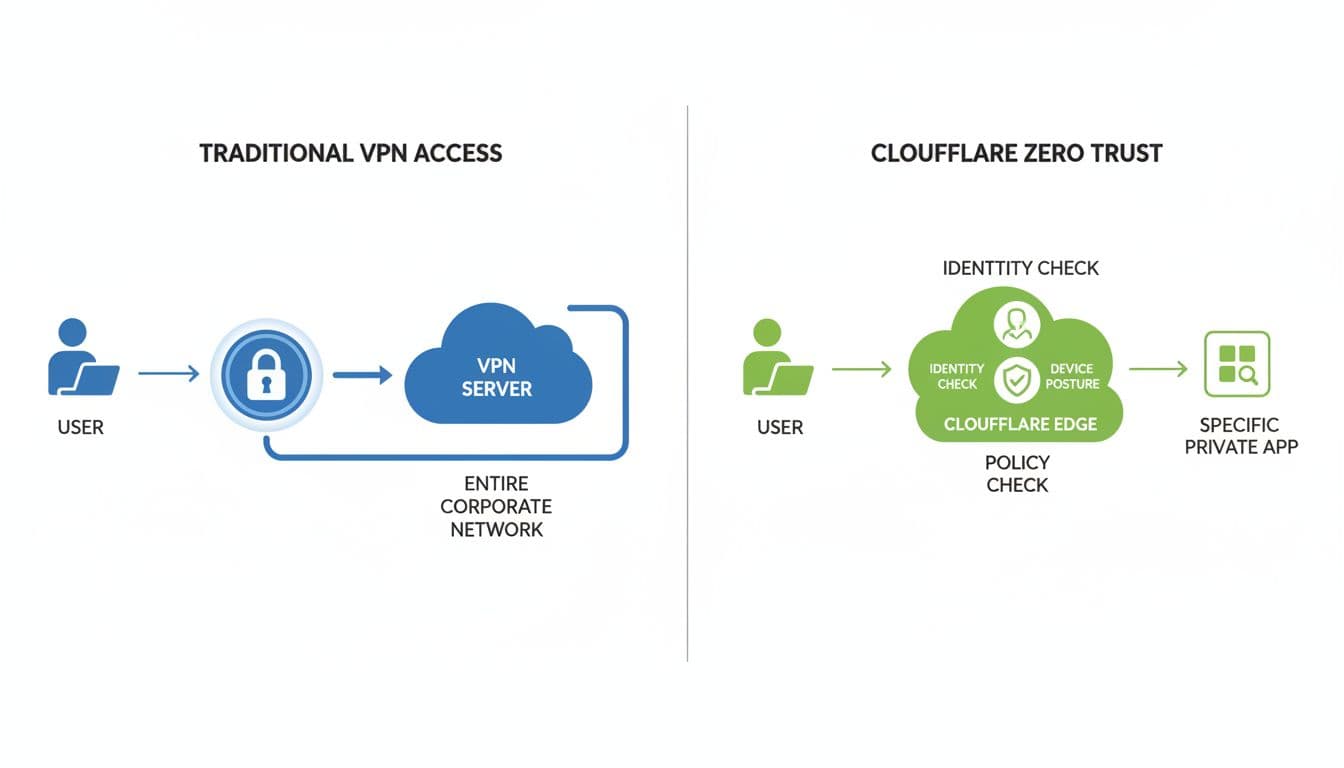
The biggest problem with a legacy VPN isn’t that it fails every day. It’s that it assumes trust too early. Once a user connects, they often gain broad network access to the entire corporate network. If one endpoint is compromised, the attacker may get room for lateral movement.
That mismatch shows up in business terms first. Users see slow logins. IT sees overloaded gateways. Finance sees renewal and maintenance spend that never seems to shrink.
Signs your current VPN is turning into a bottleneck:
- People complain about slow login or dropped sessions
- Access exceptions keep piling up
- Your team spends too much time on IP whitelisting
- Cloud apps still hairpin through old data centers
- Support tickets spike every time remote traffic jumps
The cost isn’t only the license. You also pay for patches, client software issues, firewall changes, DNS resolution problems, split tunnel tuning, and the human cost of constant troubleshooting.
2026 reporting collected by CIO, Cybersecurity Insiders, and SNS Insider shows 81% of organizations have started or completed Zero Trust programs, while 65% plan to replace VPNs this year. That shift is as much about time and complexity as security.
What changes when your workforce goes hybrid or fully remote
When your apps live in SaaS, cloud infrastructure, and scattered data centers, perimeter security loses its shape. Your users, devices, and data are no longer in one building.
That makes broad network access feel like handing out a master key when people only need one room.
What to use instead of a traditional VPN
Most enterprises now compare four paths: Cloudflare Zero Trust, other ZTNA products, full SASE platforms, and self-hosted point solutions.
This quick table keeps the comparison practical.
| Option | Access model | Speed and path | Best fit |
|---|---|---|---|
| Cloudflare Zero Trust | App-level, based on identity and device | Uses global edge, avoids backhaul | VPN replacement for remote work |
| Standalone ZTNA tool | App-level access | Usually good, varies by POP reach | Teams focused only on private apps |
| Full SASE platform | ZTNA plus SWG, CASB, more | Strong, broader stack | Large security consolidation projects |
| Self-hosted point solution | Often tunnel or gateway based | Depends on your ops team | Narrow use cases, lower upfront cost |
For broader vendor context, CIOPages’ guide to zero trust network access is a useful benchmark.
How Cloudflare Zero Trust compares with other options
Cloudflare Zero Trust usually wins on ease of deployment, global edge reach, and the ability to mix web, SSH, RDP, DNS, and private app controls in one dashboard. Zscaler, Palo Alto, and Netskope often appeal to buyers who want a larger SSE or SASE stack. Self-hosted options give you control, but you keep the maintenance burden.
TerraZone’s 2026 enterprise ZTNA comparison lines up with what many buyers see in practice: vendor choice depends on how much platform depth, data controls, and operational overhead you want.
Should you still keep a VPN anywhere in your stack?
Yes, sometimes. Keep the existing VPN for rare admin paths, old private network tools, or niche port-based access that won’t move cleanly yet. Reduce it for engineers who still need special SSH or RDP patterns. Retire it for routine employee remote access.
That decision rule keeps your vpn replacement project honest.
What Cloudflare Zero Trust is, and how it works for remote work
Cloudflare Zero Trust gives users access to apps, not the entire network. A user signs in through an identity provider, passes authentication, meets device posture checks, and then gets routed to the specific service allowed by policy. That is a zero trust model in plain English.
If you want a broader view of the platform, Spendbase has a good primer on what Cloudflare is used for.
User -> SSO and identity provider -> device posture check -> Cloudflare Access policy -> private resource The endpoint reaches one app, not the whole network.
The building blocks behind the platform
Cloudflare One is the larger platform. Inside it, Cloudflare Access handles zero trust access, the Cloudflare WARP client connects managed devices, Cloudflare Gateway applies DNS policies and web filtering, and Cloudflare Tunnel uses cloudflared to connect internal services without opening an inbound port on your firewall.
Your zero trust dashboard ties those parts together. You write access policies based on user identity, group, device posture, country, or network policies. You can also protect application servers, Kubernetes services, and private resources behind a public hostname without exposing them directly.
Where Cloudflare Zero Trust makes the most sense
It fits best when remote users need secure access to internal applications, contractors need limited onboarding, and your team wants zero trust network access without backhauling traffic through old data centers.
That’s why companies like Ocado used Cloudflare to replace a legacy VPN and move to default-deny, identity-based controls, as shown in Ocado’s Cloudflare case study.
Free virtual cards for non-EU residents
Open in 1 working day, issue 100 virtual cards, and get up to 1.25% cashback.
Get a free account
The business benefits enterprise teams care about most
Leadership usually cares about three things: lower risk, less friction, and lower operating drag. Cloudflare Zero Trust addresses all three when you deploy it well.
Applied Systems is a useful example. In Cloudflare’s published materials, it replaced a sluggish VPN and outbound internet access stack, then gained more granular access control, simpler administration, and a better user experience. Indeed moved even faster.
In Indeed’s customer story, the company deprecated its VPN in a little over three months, rolled Cloudflare out to more than 13,000 employees and contractors, and used Terraform for policy automation.
| Case or metric | Reported outcome |
|---|---|
| Indeed | VPN removed in just over 3 months |
| VistaPrint | First phase cut perimeter vulnerabilities by 20% |
| 2026 switchers | 20% to 30% lower first-year costs in recent reports |
Security gains that matter to leadership
A zero trust architecture narrows blast radius. Access is based on identity and device, not a blanket network join. That helps with preventing lateral movement, reducing attack surface, and tightening control over internal applications.
Performance and user experience improvements
Users often feel fewer hoops. They don’t join the entire network just to open one app. Traffic can use Cloudflare’s global edge instead of bouncing through a single VPN server. In VistaPrint’s customer story, the move away from on-prem VPN backhaul also improved the end-user experience.
Cost, compliance, and operations benefits

This is where finance pays attention.
| Cost area | Legacy VPN pattern | Cloudflare Zero Trust pattern |
|---|---|---|
| Access ops | Server upkeep, patches, port changes | Cloud-delivered controls |
| Support load | More tickets, more client issues | Fewer broad-access fixes |
| Audit trail | Harder to map full network access | Clearer app-level logs |
| Pricing context | Hardware plus labor | Free tier, then about $7/user/month, enterprise custom |
For a quick benchmark, Spendbase advertises up to 25% off Cloudflare. That gives you a useful price reference when you compare a vpn with Cloudflare Zero Trust against your current support and maintenance spend.
How to replace your legacy VPN without breaking remote work
You don’t rip this out in one weekend. You phase it.
- Inventory every app, user group, DNS dependency, and existing vpn rule.
- Pilot a few low-risk internal applications with Cloudflare Access and Cloudflare Tunnel.
- Roll out the cloudflare warp client to a small group, then expand in waves.
- Keep the old VPN as a short-term backup.
- Measure login success, ticket volume, and latency before full cutover.
Current: remote user -> VPN server -> entire corporate network Target: remote user -> WARP client -> Cloudflare Tunnel -> specific app
A phased rollout that reduces risk
Start with a pilot group that includes one vocal skeptic. If they can work without pain, your next wave gets easier. Keep rollback plans ready, review DNS queries and split tunnel behavior, and train users on the new login flow.
Common migration mistakes to avoid
Teams usually trip over old DNS records, forgotten firewall rules, weak SSO setup, or access policies that are too loose or too strict. Moving everything at once is the biggest mistake.
Pros and cons of moving to Cloudflare Zero Trust
A balanced view matters before you replace your VPN.
| Pros | Cons |
|---|---|
| Fast to deploy for many web and private app cases | Policy design takes planning |
| Strong access control based on identity and device | Some older SSH, RDP, or port-heavy flows need extra work |
| Better visibility in one dashboard | Change management still matters |
| Less need for IP whitelisting and full network access | A few teams may keep a VPN for edge cases |
The biggest reasons teams like it
You get speed, control, visibility, and better support for modern remote work. Your users stop asking for the whole network when they only need one app.
The main tradeoffs to think through
Some non-web use cases still need careful testing. If your environment depends on unusual ports, old client software, or custom network policies, plan the migration before you decommission traditional vpns.

We can unlock discounts on 10,000+ tools you already use.
Final thoughts
Your legacy VPN can still earn its keep in a few corners. For everyday remote access, though, it often creates poor user experience and wider risk than you want.
A modern zero trust network gives you a better fit for how people work now. Review where your VPN is still needed, pilot a few apps with Cloudflare Zero Trust, and compare the real cost of broad network access against app-level control.


Get discounts on your team’s favorite apps
Find deals for 10%, 30%, or even 70% off in our discount marketplace.
Check Discounts